

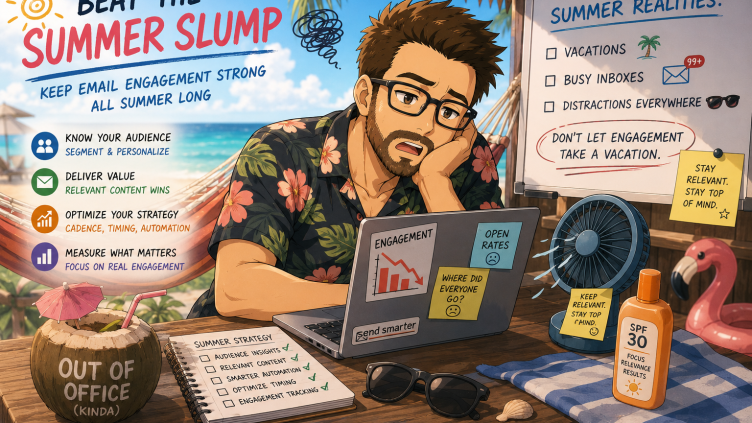
For many marketers, summer can feel a little unpredictable.
Engagement dips. Response times slow down. Campaign performance starts fluctuating for reasons that aren't always obvious. And suddenly, strategies that felt rock-solid in March don't seem quite as effective in June or July.
Part of that is seasonal. People are traveling more, taking time off, and simply spending less time glued to their inboxes. But another part of it comes down to something marketers are dealing with more than ever before: subscriber fatigue.
And frankly, it's becoming harder to ignore.
What subscriber fatigue actually looks like
Subscriber fatigue doesn't always show up dramatically.
Sometimes it's obvious: falling open rates, lower click-through rates, rising unsubscribes. But more often, it happens gradually. Engagement slowly tapers off over time until your audience starts tuning your brand out altogether.
Usually, it comes down to a few common issues:
- Sending too frequently
- Sending content that feels repetitive
- Poor audience segmentation
- Generic messaging
- Over-reliance on promotional emails
- Failing to adapt to changing customer behavior
The reality is that today's consumers are overwhelmed with marketing messages. Every inbox is crowded, attention spans are shorter, and customers are becoming increasingly selective about which brands they engage with.
That means relevance matters more than ever.
More emails doesn't always mean better results
When engagement starts slipping, many brands instinctively try to compensate by sending more.
More promotions. More reminders. More "just checking in" emails.
But if the content itself isn't resonating, increasing send volume can actually make the problem worse.
The brands seeing the strongest engagement right now aren't necessarily the ones sending the highest volume of emails. They're the ones delivering the most relevant experiences.
That could mean:
- Adjusting send cadence based on engagement behavior
- Building smarter audience segments
- Personalizing content more thoughtfully
- Creating lifecycle-specific campaigns
- Using automation strategically instead of excessively
Funny enough, the future of email marketing is starting to feel a little more human again.
Summer is a great time to audit your strategy
Mid-year is actually the perfect opportunity to step back and evaluate what's working and what isn't.
Instead of focusing solely on short-term campaign performance, smart marketers use this time to look at the bigger picture:
- Which audience segments are most engaged?
- Which campaigns are consistently underperforming?
- Where are customers dropping off?
- Are your automations still aligned with customer behavior?
- Is your current platform supporting your goals effectively?
In many cases, engagement issues aren't just content problems. They're operational ones.
Outdated automations, disconnected customer data, poor segmentation capabilities, or limitations within your ESP can all contribute to declining engagement over time.
Why your email platform matters
As customer expectations evolve, businesses need email platforms that can support smarter personalization, stronger automation, and more meaningful reporting.
Platforms like Salesforce Marketing Cloud and Silverpop offer powerful tools for behavioral targeting, customer journey automation, segmentation, and engagement tracking. But choosing the right platform and using it effectively are two very different things.
And for businesses considering a platform migration, the process can feel overwhelming fast.
Data migration. Deliverability concerns. Rebuilding automations. Retraining teams. Preserving reporting integrity. There's a lot that goes into making a transition successful.
That's where having the right partner matters.
How Kempler Consulting helps brands stay ahead
At Kempler Consulting, we help businesses bridge the gap between where their email marketing strategy is today and where they want it to be tomorrow.
Whether you're trying to improve engagement, optimize your existing campaigns, or transition to a platform that better fits your long-term goals, we work alongside your team every step of the way.
From strategy and segmentation to platform migration and campaign execution, our goal is simple: help you create email experiences your customers actually want to engage with.
Because avoiding the summer slump isn't really about sending more emails.
It's about sending smarter ones.